

Airless Containers Vs Traditional Cosmetic Bottles: Which Packaging System Fits Your Product Best?
Cosmetic packaging has a direct relationship with formula stability, dispensing performance, production efficiency, and the overall user experience. For brands developing skincare, makeup, or personal care products, choosing between an airless container and a traditional cosmetic bottle is therefore more than a matter of appearance.
Traditional bottles remain practical for many formulations because their structures are simple, familiar, and generally economical. Airless containers, on the other hand, are designed around a different dispensing principle: the formula is pushed upward through a vacuum or piston mechanism rather than being repeatedly exposed to incoming air.
The better option depends on the formulation, dosage requirements, filling process, expected shelf life, and target market.

How Airless and Traditional Bottles Work Differently?
A conventional cosmetic bottle usually relies on a dip tube, dropper, or simple pump mechanism. When product is dispensed, the internal volume needs to be replaced by air. With repeated use, the formula can therefore experience more contact with the surrounding environment.
An airless container uses a piston or similar vacuum-driven structure. When the pump is pressed, the internal mechanism moves the product toward the dispensing outlet. This reduces the need for air to enter the main product chamber.
This structural difference becomes particularly important when packaging formulas containing oxidation-sensitive or high-value ingredients. Airless packaging is commonly used for serums, lotions, creams, and other skincare formulations where controlled dispensing and reduced exposure are important.
Dispensing Accuracy Can Affect Product Economics
Dosage control is often overlooked during packaging selection.
With a traditional bottle, the amount dispensed may vary depending on the pump structure, user pressure, product viscosity, and how the container is held. This may be acceptable for products where dosage precision is not critical.
Airless systems are generally designed to provide a more controlled amount per pump. For high-value serums, creams, and treatment products, consistent dispensing can help consumers use a similar quantity each time and reduce unnecessary product waste. LDM's airless packaging range, for example, emphasizes controlled dispensing and consistent output as part of its product design.
For B2B buyers, this also creates a useful testing point: instead of only checking the stated pump output, samples should be tested across multiple cycles and with the actual formula to evaluate output consistency.
Airless Containers vs Traditional Bottles: Key Differences
| Factor | Airless Containers | Traditional Cosmetic Bottles |
|---|---|---|
| Air exposure | Low during dispensing | Usually higher |
| Dosage control | Generally more consistent | Depends strongly on pump or closure |
| Formula protection | Suitable for sensitive formulations | Sufficient for many stable formulas |
| Product residue | Can reduce remaining product | More dependent on bottle geometry |
| Structure | More components and mechanisms | Usually simpler |
| Initial packaging cost | Usually higher | Usually lower |
| Filling compatibility | Requires system-specific testing | Often easier to standardize |
| Best suited for | Serums, creams, active skincare | Lotions, cleansers, basic personal care |
| Customization | Pump, capacity, finish, structure | Broad range depending on bottle design |
The table should be treated as a starting point rather than an absolute rule. A traditional bottle can outperform an airless package for a particular formula if the dispensing system, material, and closure are better matched to the product.
How Does Packaging Material Affect Product Performance?
The container material should be evaluated together with the dispensing mechanism.
PP is commonly used in cosmetic packaging because of its chemical resistance and processing characteristics. PET can be considered when transparency and appearance are important. Acrylic structures may be selected when brands want a more substantial visual presentation.
However, material selection should not be based purely on appearance. Formula compatibility, stress cracking, migration considerations, dimensional stability, impact resistance, and surface finishing requirements should all be evaluated.
For example, a premium-looking bottle that reacts poorly with the formula is not a successful packaging solution. Likewise, a structurally strong package may still create problems if its pump cannot handle the viscosity of the product.
When Traditional Bottles May Be the Better Choice?
Airless packaging is not automatically the best option for every cosmetic product.
Traditional bottles can make more sense when the formula has good stability under normal use and does not require a highly controlled dispensing environment. They can also be advantageous for brands prioritizing simple assembly, familiar filling processes, or lower packaging costs.
For high-volume products with relatively low unit value, packaging economics can become especially important. If an airless system increases the packaging cost without producing a meaningful improvement in product protection or consumer experience, the additional structure may not be justified.
Traditional packaging can also provide more flexibility in certain product formats, especially where transparency, direct visual inspection, or a simple dispensing mechanism is important.
When Airless Packaging Becomes More Valuable?
Airless containers are particularly worth considering when several requirements appear together:
The formula contains oxygen-sensitive active ingredients.
Product contamination needs to be minimized during repeated use.
Accurate dosing is important.
The formula has a relatively high unit value.
Reducing product residue is commercially meaningful.
The product is positioned as premium skincare.
The brand needs a modern dispensing experience.
The formula has a viscosity that benefits from controlled pump delivery.
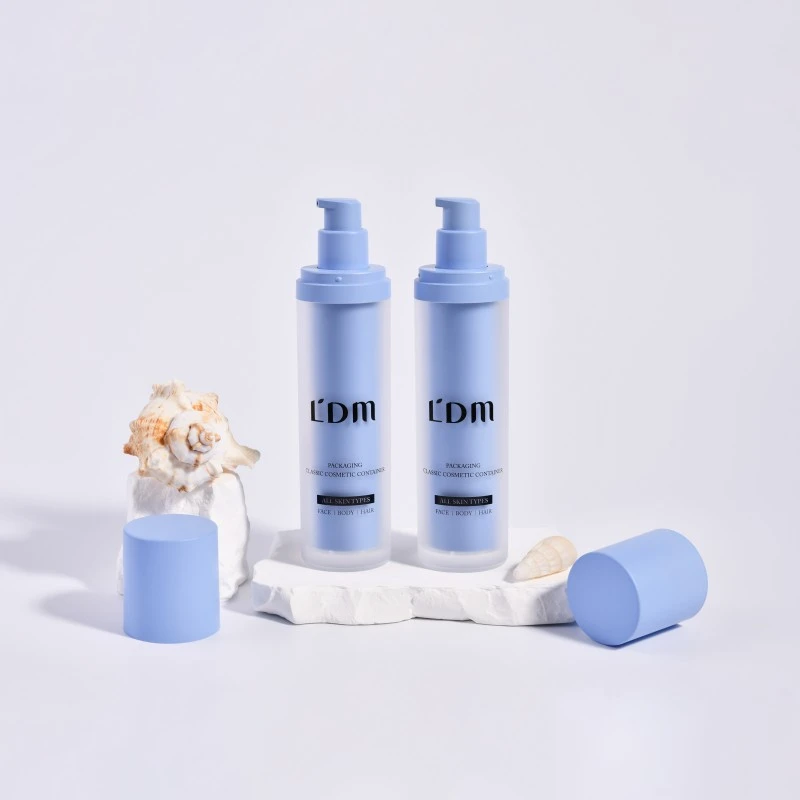
LDM's current product range includes different airless pump structures, capacities, materials, finishes, and customized options, allowing the packaging format to be adapted to different cosmetic applications rather than using one standard container for every formula.
What Buyers Should Test Before Bulk Ordering?
For professional procurement, visual inspection alone is not enough. Before approving a packaging system for mass production, buyers should evaluate several practical factors.
Formula Compatibility
Fill the actual formula into the proposed container and monitor changes during storage and repeated dispensing. Pay attention to color, odor, viscosity, separation, and other relevant formulation characteristics.
Pump Performance
Measure the output per stroke and check whether it remains consistent after repeated operation. The first few pumps and the final dispensing stage can behave differently.
Leakage and Sealing
Packages should be tested under transportation and storage conditions. In addition to static leakage, buyers should consider vibration, pressure changes, and different orientations during shipping.
Residual Product
The amount of product remaining inside the package at the end of its useful life can affect both consumer satisfaction and product economics. Container geometry and piston movement should therefore be evaluated together.
Decoration Durability
Printing, spraying, UV finishing, hot stamping, or other decorative processes should be tested for adhesion and abrasion resistance. LDM supports customized colors, logos, spraying, electroplating, UV and hot-stamping processes for cosmetic packaging.
How Does LDM Packaging Approach Cosmetic Packaging?
Shaoxing Longderm Plastic Co., Ltd. focuses on cosmetic and personal care packaging, with product categories including cosmetic bottles, airless pump bottles, deodorant containers, and cosmetic jars. The company states that its capabilities cover structural development, mold manufacturing, OEM/ODM customization, and mass production.
For brands evaluating airless packaging, this type of manufacturing capability is important because the package must be considered as a complete system rather than simply a bottle body. Pump structure, capacity, material, surface finish, sealing, and formula compatibility all need to work together.
LDM also provides customization in areas such as bottle design, capacity, color, logo, pump structure, and surface treatment, supporting packaging development for different skincare and personal care applications.


Consideration
There is no universal winner between airless containers and traditional cosmetic bottles.
Traditional bottles remain a practical choice for stable formulas, high-volume products, and applications where simple construction and cost efficiency are priorities. Airless containers become more valuable when formula protection, controlled dosage, reduced air exposure, and product utilization are important.
For cosmetic brands, the best packaging decision should therefore begin with the formula and usage requirements, followed by compatibility testing, dispensing evaluation, transportation testing, and cost analysis. Once these factors are clear, the choice between airless and traditional packaging becomes a technical procurement decision rather than simply a matter of packaging appearance.
Previous: No Information