

Top 5 Airless Pump Containers Manufacturers In China
China has a broad cosmetic packaging supply chain, offering standard airless bottles, customized container designs, different capacities, and decorative finishes. When selecting a manufacturer, buyers should consider not only unit price and appearance but also formula compatibility, pump performance, filling requirements, order quantity, and quality control.
The following five Chinese suppliers are potential starting points for sourcing airless pump containers. The list is not a ranking by market share or production capacity; buyers should confirm current product availability and manufacturing arrangements directly.

Top 5 Airless Pump Containers Manufacturers in China
|
Manufacturer |
Location |
Main packaging focus |
|---|---|---|
|
Shaoxing Longderm Plastic Co., Ltd. |
Shaoxing, Zhejiang |
Airless pump bottles and cosmetic packaging |
|
Zhejiang Cosme Industry Co., Ltd. |
Shaoxing, Zhejiang |
Airless bottles, jars, and tubes |
|
Zhejiang UKPACK Packaging Co., Ltd. |
Zhejiang |
Airless bottles, pumps, and customized cosmetic packaging |
|
Ningbo Shiny Packaging Co., Ltd. |
China |
Cosmetic packaging and dispensing containers |
|
Ningbo Jiali Plastics Co., Ltd. |
China |
Cosmetic bottles and skincare packaging |
Shaoxing Longderm Plastic Co., Ltd.
Shaoxing Longderm Plastic Co., Ltd. was established in 2016 and specializes in cosmetic packaging products. Its product range includes airless pump bottles, cosmetic bottles, deodorant containers, and cosmetic jars for skincare, beauty, and personal care applications.
Longderm's main product categories and packaging options include:
- Airless Pump Bottles: Packaging options for skincare formulations, with specifications depending on the selected bottle and pump model.
- Cosmetic Bottles and Jars: Different container formats for products such as lotions, creams, and other cosmetic formulations.
- Deodorant Containers: Packaging designed for deodorant products in different formats.
- Customization Options: Buyers can discuss bottle color, logo printing, surface decoration, capacity, and component selection according to product availability and project requirements.
For airless pump container projects, key considerations include bottle dimensions, pump configuration, dispensing output, material compatibility, and filling requirements. These details should be confirmed with the selected model before sampling and production.
Longderm also works with project-specific packaging requirements. Buyers can discuss sample availability, minimum order quantities, customization feasibility, and production lead times according to the selected product and order specifications.
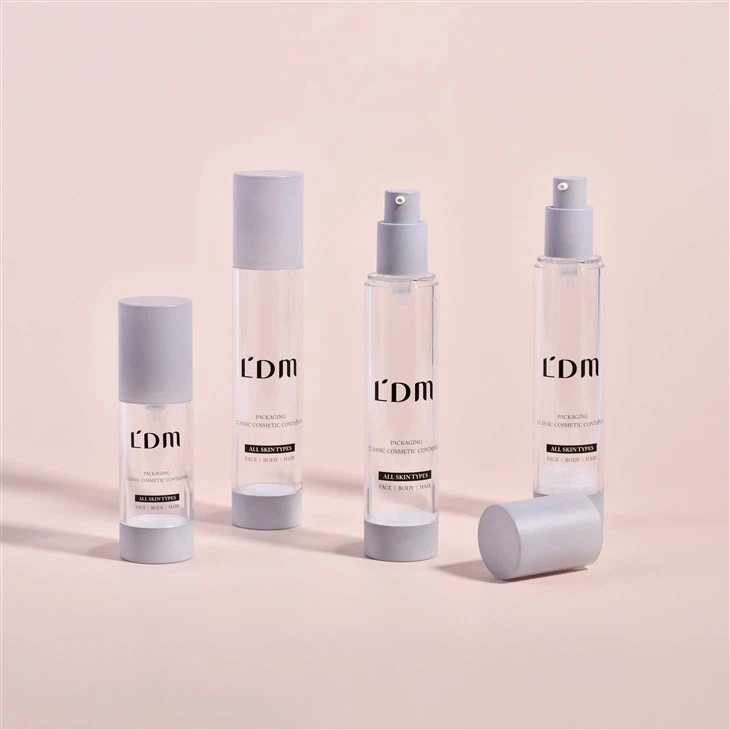
Vacuum Cosmetic Bottle

Matte Airless Pump Bottle

Airless Cosmetic Pump Container
Zhejiang Cosme Industry Co., Ltd.
Founded in 2015, Zhejiang Cosme Industry Co., Ltd. offers airless bottles alongside cosmetic bottles, jars, tubes, and customized OEM/ODM packaging. Its product development and mold capabilities may suit projects requiring coordinated packaging formats or customized container designs.
Zhejiang UKPACK Packaging Co., Ltd.
UKPACK is a China-based cosmetic packaging manufacturer established in 2014, offering airless bottles, airless jars, pumps, and other personal care packaging. Its services cover packaging design, tooling, sampling, testing, decoration, and mass production.
Ningbo Shiny Packaging Co., Ltd.
Ningbo Shiny Packaging is a name buyers may encounter when researching cosmetic packaging and dispensing containers. Confirm its current airless bottle catalogue, factory arrangements, and available customization options before treating it as a qualified supplier.
Ningbo Jiali Plastics Co., Ltd.
Ningbo Jiali Plastics is another potential supplier to investigate for cosmetic and skincare packaging. Buyers should request current product specifications and verify whether its available airless containers match their capacity, material, pump, and order requirements.
How Do I Choose the Right Airless Pump Container for My Product?
Start with the formula's viscosity, intended dosage, and packaging capacity. A lightweight serum may require a different pump output from a thick cream, so buyers should test the actual formula in samples rather than selecting a container based on appearance alone.
Before requesting quotations, define:
- Formula type and viscosity.
- Required fill volume, such as 15 ml, 30 ml, 50 ml, or 100 ml.
- Desired output per pump stroke.
- Bottle shape, dimensions, and preferred material.
Whether the package must work with an existing filling line.
What Is the Difference Between an Airless Bottle and a Regular Pump Bottle?
A regular pump bottle generally draws product through a dip tube, while an airless system typically uses a piston or another mechanism to move the product toward the dispensing pump.
|
Comparison |
Airless pump bottle |
Regular pump bottle |
|---|---|---|
|
Dispensing structure |
Often uses a piston or vacuum-based mechanism |
Commonly uses a dip tube |
|
Air exposure |
Designed to reduce air entering the container during dispensing |
Air may replace the dispensed product inside the bottle |
|
Formula compatibility |
Must be tested with the specific pump and container |
Must also be checked against the formula and pump |
|
Product evacuation |
Often designed to reduce leftover product |
Product may remain below the dip tube |
|
Cost considerations |
May involve a more complex component structure |
Can have a simpler construction, depending on the design |
Neither system is automatically suitable for every formula. The final choice should depend on dispensing performance, compatibility, cost, and the product's intended use.
Which Materials Should I Consider for Airless Pump Containers?
Common material choices include PP, PET, PETG, and other plastics, depending on the design and individual components. Some packages also combine plastic with acrylic, metal-look parts, or other decorative materials.
When comparing materials, ask suppliers about:
- Chemical compatibility with the formula.
- Resistance to cracking, deformation, or discoloration.
- Transparency and appearance requirements.
- Compatibility with printing, coating, or other decoration.
- Material identification and recycling considerations.
The bottle body, pump, seals, and piston may use different materials. Confirm the component-level specifications rather than assuming the entire container is made from one plastic.
Can Airless Pump Containers Be Customized?
Many manufacturers offer customization for standard models, while more substantial structural changes may require new tooling.
Typical options include:
- Bottle color and opacity.
- Logo printing and surface decoration.
- Capacity and external dimensions, subject to the existing design.
- Pump and cap appearance.
- Refillable structures or other special configurations, where available.
Ask whether the requested changes can be made to an existing mold. This can help clarify development costs and lead times before the project proceeds.
How Can I Compare Quotations from Different Manufacturers?
Make sure each supplier quotes the same packaging configuration. A quotation may cover the bottle and pump only, while another may include the cap, decoration, assembly, and individual packing.
Ask each supplier to specify:
- Unit price at several order quantities.
- Included components and decoration.
- MOQ for each model and color.
- Sample and tooling charges.
- Production lead time and shipping terms.
- Quality inspection arrangements and replacement terms for defective goods.
Compare the total landed cost as well as the quoted unit price. Freight, customs duties, packaging, and tooling can materially change the overall cost of a project.
What Tests Should I Conduct Before Mass Production?
Approve samples using the actual formula and, where possible, the intended filling process. A container that looks correct may still have problems with priming, leakage, or consistent dispensing.
Recommended checks include:
- Pump performance: Test priming, dispensing consistency, and output per stroke.
- Leakage: Check the assembled package under relevant storage and transport conditions.
- Formula compatibility: Observe changes in the formula and packaging during an agreed test period.
- Assembly: Confirm that the pump, cap, bottle, and other components fit correctly.
- Decoration: Check color, printing position, adhesion, and surface finish.
- Filling-line suitability: Verify that the container can be filled and assembled using the planned process.
Record the approved sample, critical dimensions, and acceptance criteria before authorizing bulk production.
How Can I Reduce Risks When Sourcing from a Chinese Manufacturer?
Begin by checking the supplier's business information, product range, manufacturing arrangements, and experience with the required container type. Request samples and technical details before placing a large order.
For customized projects, document the approved specifications, sample reference, inspection criteria, production schedule, and responsibilities for defective products. If the project is commercially significant, consider a pre-shipment inspection before the goods leave the factory.
Previous: No Information